THE "MARKET REVENGE" EFFECT: WHEN EMOTIONS BLOW UP YOUR ACCOUNT IN A MOMENT OF IMPULSE
Let's be honest, there is a brutal moment that anyone who has ever placed a trade has experienced: You analyze thoroughly. You confidently pull the trigger. The price moves in your direction for a bit, then suddenly reverses. A lightning-fast spike hits your Stop Loss by a mere... 1 pip. And immediately after, like a cruel joke, the price turns around and heads straight for your original target.
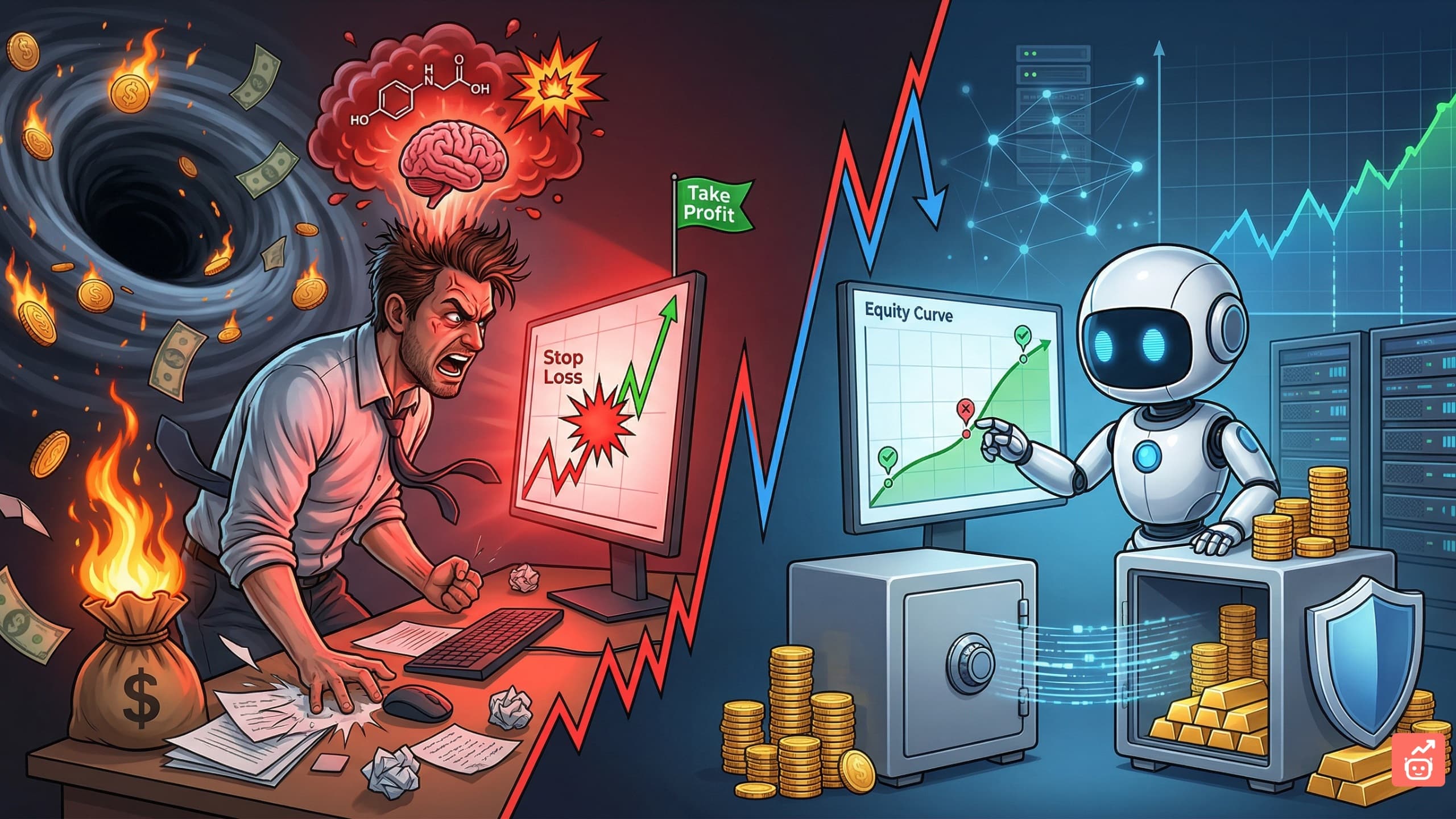
At that very second, your chest tightens. A toxic chemical cocktail called "Resentment" pumps straight to your brain. Your ego is deeply wounded. You feel as if the market has eyes, is watching you, and is deliberately mocking you.
And then, instead of closing your laptop to take a break, your hands tremble as you reach for the mouse. You immediately place a new trade, doubling the volume with only one desire: "Give me my money back!".
Welcome to Revenge Trading – the black hole that swallows 90% of accounts faster than any technical analysis error ever could.
The "Rationality Blackout" moment and rock-bottom financial IQ
When you fall into a state of revenge, you are no longer an investor. Biologically, anger triggers the amygdala (the brain's emotional processing center) and immediately "cuts the power" to the prefrontal cortex – the area responsible for logical thinking and risk management.
Your financial IQ plummets. The rules you swore to follow (only risking 1% of capital, waiting for trend confirmation) are thrown out the window. That mouse click to place a revenge trade contains no statistical edge. It is merely the scream of an ego trying to soothe the pain of being rejected by the market. You are using real money to buy a fake emotional release.
The Illusion of Control
The root of resentment often stems from a deep psychological bias: The Illusion of Control. We secretly believe that if we analyze well enough, we can force the price to move according to our will.
But the truth is often cold: The financial market is an inanimate and random entity in the short term. It has no eyes, no emotions, and most importantly—it doesn't know who you are. The market does not "intentionally" sweep your stop loss; it is merely the inevitable shift of liquidity from millions of other players.
Being angry and wanting to "revenge" the market is exactly like punching a rock just because you tripped over it. The rock feels no pain, only your hand bleeds, and your account evaporates.
Forcing new trades to carry "Emotional Baggage"
In probability theory, the 100th trade has absolutely nothing to do with the 99th. They are independent events. But when angry, you load the new trade with an absurd mission: It must carry its own profit while simultaneously compensating for the bitter loss of the previous trade.
This impatience causes you to enter trades hastily at precarious price levels, over-leveraging beyond safe limits. By combining past emotions into present decisions, you have personally broken the survival equation, pushing the risk of blowing your account to the red alert level.
The Solution: Setting up a "Circuit Breaker" to protect capital
The revenge state is a form of intoxication, and you cannot use logic to reason with someone who is drunk. What you need to do is build a strict defense system before the resentment strikes.
Approach 1: If you are a manual trader
You must set up a "Circuit Breaker" system similar to major stock exchanges:
Daily Drawdown Limit: Commit that if you lose 2 consecutive trades, or your account is down 2% for the day, you MUST close your computer.
Change your physical state: When you hit the loss threshold, stand up and leave your desk immediately. Science proves the brain needs at least 30 minutes for stress hormone levels to cool down, returning control to the prefrontal cortex.
Approach 2: The manager's mindset with Automated Systems (EA/Bot)
The harsh reality is: 99% of manual traders have personally broken their daily stop-loss rules due to a moment of impulse. If you know you cannot defeat your instincts, delegate the execution to automated algorithms.
That is why professional EA/Bot systems always demonstrate superiority in protecting capital. The machine has no "ego" to be wounded.
When it hits a stop loss, it doesn't get bitter. It coldly records it as a pre-programmed "operating cost".
With advanced features like Maximum Loss Amount or Auto-DCA spread adjustment, the Bot will automatically lock trades or adjust safety distances when the market enters a storm – something a heated brain can never do.
The Bot's next trade will still be executed sharply and accurately without carrying any "emotional baggage" from the past.
Ask yourself: Are you trading or gambling?
If you still find yourself stuffing trades after a loss, you are not investing – you are paying to buy a fake emotional release. And the price you pay is usually all the money in your account.
Conclusion: The pinnacle of management is indifference
The biggest difference between a gambler and a quantitative expert is not who draws better charts. That boundary lies in how they react after a losing trade.
The financial market never distributes profits to hot heads. If you are still placing trades manually, learn to cultivate the indifferent stillness of a machine. Or better yet, let a machine do that part for you. Never argue with an inanimate entity, because in the end, the market always has much more endurance than you do!
- RedBot Team
Share this insight with your trading network
If you found this article valuable, help us spread the knowledge by sharing it on your social channels.